
Last updated: November 18, 2026. This article summarizes public research and state laws. It isn’t legal advice. Check your state’s statute for the exact rules.
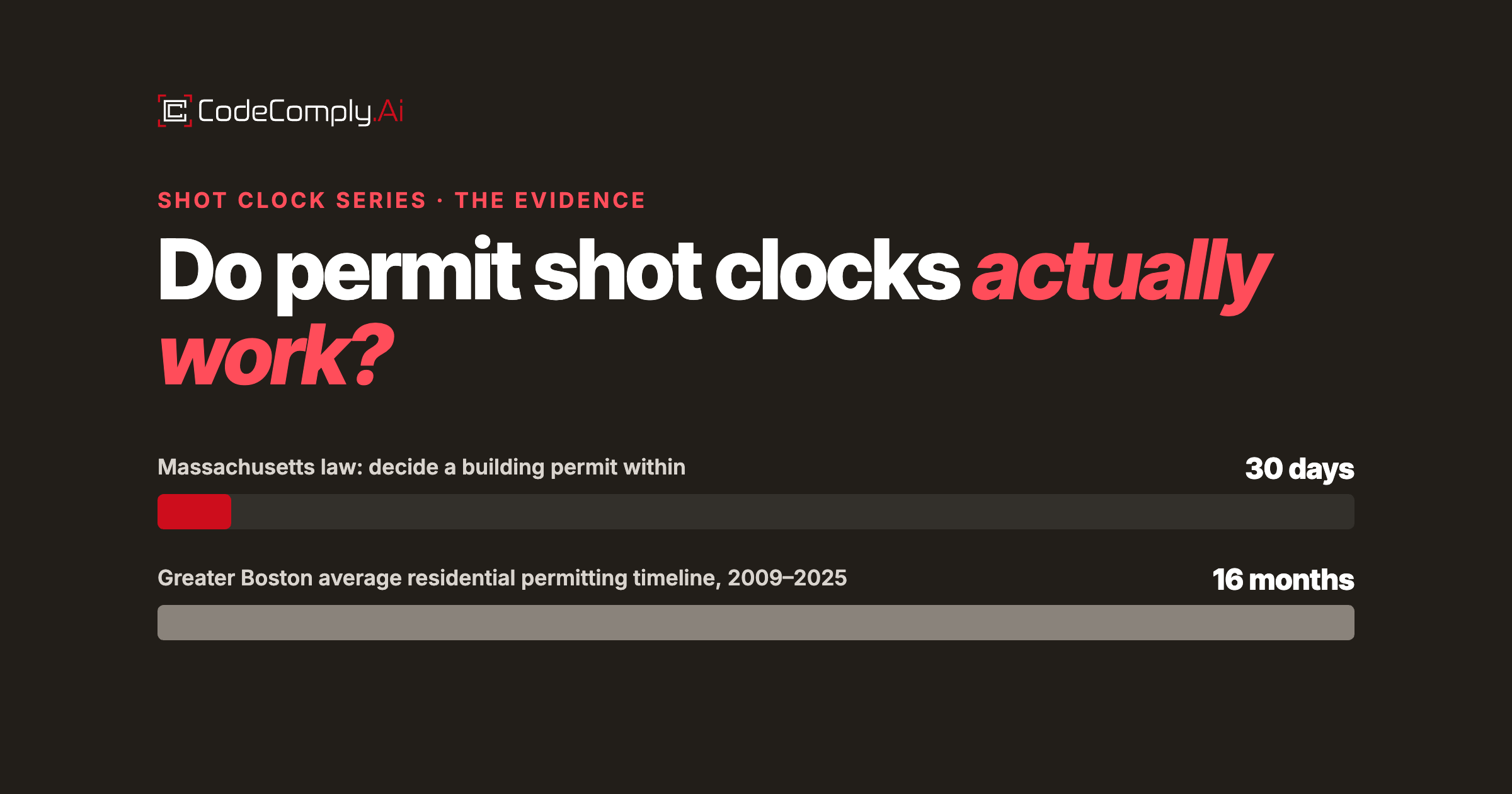
Massachusetts already has a permit shot clock. Its state building code tells local building officials to issue or deny a permit “within 30 days of filing” (780 CMR 105.3).
Yet from 2009 to 2025, the average residential permitting timeline in Greater Boston was 16 months, according to Pioneer Institute economist Andrew Mikula. In San Antonio and Jacksonville, it averaged under two months (Banker & Tradesman).
Those two numbers don’t measure the same thing. The 30-day rule covers the building permit. The 16 months covers the whole path to a permit, zoning and other approvals included. That gap explains a lot about shot clocks. A deadline only speeds up the step it covers.
So do permit shot clocks work? Below is what the research shows, what cities say against them, and what we found when we read the laws themselves. If you’re new to the topic, start with how permit shot clocks work.
What the evidence says
Short answer: no one has measured it well yet.
Public support isn’t in doubt. In a 2023 Pew Charitable Trusts survey of more than 5,000 people, 86% said they’d support requiring governments to make permitting decisions faster (Route Fifty).
Research on permit delay is growing, too. A recent study by economists at Princeton and the University of Chicago looked at 1.1 million permits in 60 U.S. cities. It found that permitting, not construction, explains 30% to 43% of the gap between the slowest and fastest cities. But the study didn’t evaluate any state’s reforms. And two of the slow cities it names, San Francisco and Miami, are in states that already have shot clocks (HousingWire).
The closest thing to a result comes from California. After SB 35 streamlined review for qualifying housing projects, the median approval time in Los Angeles fell to 2.7 months, from about 7 months for similar earlier projects (Pew). SB 35 changed several things at once, though, including removing some discretionary and environmental review. Its results can’t be credited to a deadline alone.
Timing is the other problem. Many of the strongest laws are brand new. Kansas signed its law in April 2025. Indiana’s residential plan review deadline began in 2026, Georgia’s and Wyoming’s in July 2026. Tennessee’s starts January 1, 2027. There isn’t enough data yet to judge them.
Why a deadline on paper may not change much
We read the statutes behind one widely shared list of 18 shot clock states. A few patterns stood out.
Some deadlines have no real penalty
In Michigan, New Jersey and Ohio, a missed deadline counts as a denial. That mainly gives the applicant the right to appeal (MCL 125.1511; N.J.A.C. 5:23-2.16; Ohio R.C. 3791.04). In Massachusetts, the remedy is a complaint to the official’s appointing authority or an appeal. Connecticut and Wisconsin set deadlines without stating any consequence at all (Conn. Gen. Stat. 29-263; SPS 320.09).
Compare that with Pennsylvania, Kansas and Wyoming, where a residential permit is deemed approved if the deadline passes (34 Pa. Code 403.63; Kansas HB 2088; Wyoming HB 2). Rhode Island cuts the permit fee in half (R.I. Gen. Laws 23-27.3-114.1). Same idea on paper. Very different pressure in practice.
Some time the wrong step
Mikula’s critique is that most delay sits in entitlements, the zoning and planning approvals that come before a building permit. It also comes from departments that don’t share consistent review criteria. A building permit deadline doesn’t touch either one. In his words, simply requiring a faster process is “a blunt instrument of dubious effectiveness.”
Not every state times building permits, either. Washington’s and Tennessee’s laws cover land use and development review instead.
Some start late or stop often
Many clocks, especially in newer laws, don’t start until an application is complete. Most also pause while the applicant makes corrections. Those rules are fair. They also mean the official deadline can say little about how long an applicant actually waits. Our shot clock explainer covers start and pause rules state by state.
Why every state doesn’t have one
The pushback comes mostly from cities and the groups that represent them. Their concerns deserve a fair hearing.
- Safety. When Florida lawmakers debated shorter deadlines and automatic approval in 2024, the Florida League of Cities asked that staff still be able to review residential permits “without compromising the safety of our residents” (Florida Phoenix).
- Automatic approval. In March 2026, the Rhode Island League of Cities and Towns warned that approving permits “as a matter of law” could undermine “code compliance and public safety safeguards” (letter on H7563).
- Staffing and complexity. The same letter points out that review time depends on “project complexity, coordination across departments, and staffing capacity.” A fixed deadline doesn’t add reviewers.
- Who does the review. Several laws let applicants hire a third-party reviewer when a city runs late. The Rhode Island League raised conflicts of interest when that reviewer is paid by the applicant.
Supporters answer that waiting has its own costs. “Time is money,” Florida bill sponsor Rep. Tiffany Esposito said during that 2024 debate. They also point out that most laws keep the safety backstops in place. Wyoming’s 2026 law, for example, deems a late permit approved but still requires the building to pass its inspections before anyone can move in.
What the stronger clocks have in common
This part is our view, based on reading the laws above. The clocks most likely to change behavior tend to share five traits:
- They time the step that’s actually slow. A building permit deadline won’t fix a zoning backlog.
- Missing them costs something. A fee cut, a refund, a forced permit, third-party review or deemed approval.
- The completeness check has its own deadline. Otherwise the main clock can wait indefinitely.
- They limit rounds of corrections, so a review can’t restart over and over.
- The department can actually meet them. A deadline without reviewer time behind it just moves the backlog somewhere else.
The last one gets the least attention. It’s also the one a building department controls.
What this means for your department
Whether your state has a clock or not, the same work pays off.
- Measure your own turnaround. Track days with staff and days with the applicant separately. You can’t defend your timelines, or fix them, without that split.
- Fix intake first. Incomplete applications burn review rounds on missing forms instead of code questions. Tools like AI PreCheck help applicants catch gaps before they submit. We wrote more about fixing incomplete applications before the clock starts.
- Protect reviewer time. AI Plan Review flags possible code issues for reviewers to confirm. The decision stays with your staff.
- Know your state’s rules. Our free Shot Clock Readiness Checklist, on the shot clock explainer, walks through what to check.
Frequently asked questions
How many states have permit shot clocks?
It depends on what you count. One widely shared list names 18 states, but it mixes building permit deadlines, land use deadlines and other remedies. When we read the laws, about a dozen states had building permit deadlines with a real consequence. Others had deadlines with no penalty, or clocks that cover land use instead.
Do shot clocks make buildings less safe?
That’s the main worry cities raise, especially about automatic approval. Supporters note that most laws still require code compliance and inspections. Wyoming’s law, for example, still requires a building to pass its inspections before occupancy. No study has measured safety effects either way.
What happens when a city misses a shot clock deadline?
It varies widely. Florida cuts the permit fee 10% for each business day late. Georgia refunds fees. Texas lets the applicant use a third-party reviewer. Indiana requires the department to issue a permit or a limited permit. Pennsylvania, Kansas and Wyoming treat the permit as approved. In Michigan, New Jersey and Ohio, the applicant mainly gains the right to appeal.
Why don’t shot clocks always make permitting faster?
Usually because the clock covers a step that isn’t the bottleneck, carries no real penalty, or starts only after a long completeness process. Staffing matters too. A deadline doesn’t create review capacity.
What can a building department do to prepare?
Know when your clock starts and pauses, track staff time and applicant time separately, and tighten intake so fewer applications need extra rounds. The Shot Clock Readiness Checklist is a good place to start.